Energy-Saving Lighting Tips
Helpful Tips
- Keep lights low or off when not needed
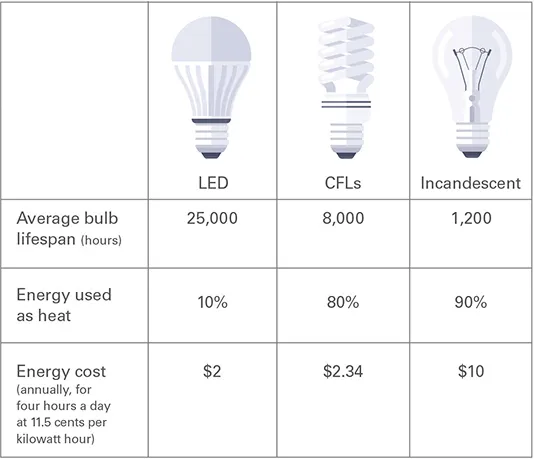
- Use LED bulbs in place of incandescent bulbs for increased energy efficiency
- Turn off lights in any room not being used
- Concentrate lighting in reading areas, work areas, and where lighting is needed for safety
- Install solid-state dimmers
- Turn off outdoor lights when not needed
- Use timers, motion detectors, heat sensors, or photocell lighting controls when possible
More Energy Savings
Switch to LED for Greater Home Energy Conservation
Beaches Energy Services wants to help you save money, while saving the environment. Switching to energy-saving lighting elements, such as light-emitting diode (LED) bulbs, will give your home better light for less money.
Today, LED bulbs come in a variety of colors, with features such as dimming capability and motion sensors. LEDs work well indoors and outdoors because of their durability. Why make the switch to LED?
- Longer lasting — LED bulbs can have a life of 25,000 hours or more, making them 3-25 times longer lasting than traditional incandescent bulbs.
- Helps with energy savings — LED bulbs use at least 75% less energy than incandescent. They reduce the amount of trapped light by emitting specific direction. Switching to LED bulbs will reduce your carbon footprint by 500 lbs and save you up to $75 per year.
- Safer — Unlike other light bulbs, LED bulbs contain no mercury and have better light quality.
- Better light quality — LEDs light up quicker than CFL bulbs, and CFLs use a great difference in the amount of energy needed to generate the level of brightness.